Blog
Exploring the Evolution of Singapore Property Cooling Measures
Published 21 January 2026
At a Glance: Singapore Property Cooling Measures
- The Seller’s Stamp Duty (SSD) holding period has been extended from 3 years to 4 years, with rates raised to discourage short-term flipping.
- For foreign buyers, the Additional Buyer’s Stamp Duty (ABSD) remains at 60% for any residential property purchase.
- As of August 2024, the Loan-to-Value (LTV) limit for HDB-granted loans is 75%.
- The Total Debt Servicing Ratio (TDSR) caps your total monthly debt repayments at 55% of your gross monthly income.
Singapore’s real estate scene has always been a dynamic landscape, attracting both local and international investors. Yet, the city-state’s thriving economy and subsequent property price increases have raised concerns about affordability and market stability.
In response, the Singapore government has implemented a series of property cooling measures over the years. These are designed to manage demand, curb speculation, and foster a sustainable housing market.
For anyone looking to invest in, buy, or sell Singapore property, understanding these measures is crucial. But what do all these acronyms — TDSR, SSD, LTV, and ABSD — actually mean?
Let’s break down the key measures before diving into their history.
Ready to sell your home? We’re ready to help.
Schedule a consultation with one of Singapore’s top agents.
Ready to sell your home? We’re ready to help.
Schedule a consultation with one of Singapore’s top agents.
Ready to sell your home? We’re ready to help.
Schedule a consultation with one of Singapore’s top agents.
Ready to sell your home? We’re ready to help.
Schedule a consultation with one of Singapore’s top agents.
Ready to sell your home? We’re ready to help.
Schedule a consultation with one of Singapore’s top agents.
What key property measure terms do I need to know?
1. Total Debt Servicing Ratio (TDSR)
The TDSR framework was introduced to encourage prudent borrowing by households and strengthen credit underwriting standards by financial institutions. In simple terms, it sets a limit on how much a home buyer can borrow. Financial institutions must ensure that a borrower’s total monthly repayment for all debts (including the mortgage, credit card bills, car loans, and personal loans) does not exceed a set percentage of their monthly income.
2. Seller’s Stamp Duty (SSD)
Stamp duty is a tax on documents related to immovable properties, such as a Sales & Purchase Agreement. The SSD is a specific tax that property owners must pay if they sell their home within a specified holding period. This measure is designed to discourage “flipping,” or buying and selling properties in a short period to make a quick profit.
Get an instant valuation for your home Access property insights and AI tools to maximise your property's potential and sell it fast Floor - Unit Property Type Home Type - Postal Code Get FREE valuation
3. Loan-to-Value (LTV) Limits
The LTV is the housing loan quantum (amount) a bank or financial institution is willing to offer as a percentage of the property’s valuation. For example, an 80% LTV limit means a buyer can borrow up to 80% of the property’s value and must pay the remaining 20% as a down payment. The LTV limit changes depending on whether it is your first, second, or subsequent mortgage.
4. Additional Buyer’s Stamp Duty (ABSD)
First introduced in December 2011, the Additional Buyer’s Stamp Duty is a tax levied on residential property purchases, paid on top of the standard Buyer’s Stamp Duty (BSD). The ABSD rate you must pay depends on your residency status (Singapore Citizen, Permanent Resident, or Foreigner) and the number of residential properties you already own.
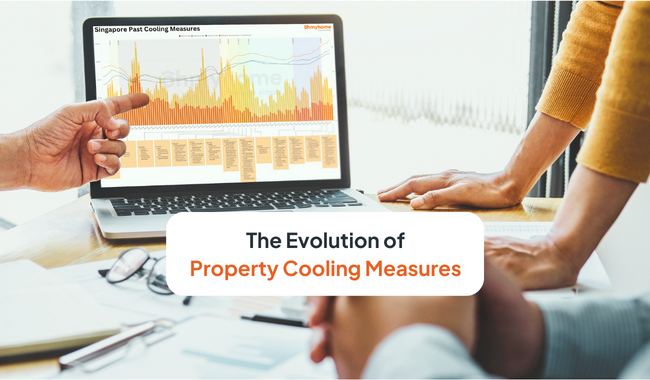
How property cooling measures in Singapore evolved
What were the changes in cooling measures over the years?
Jump to a specific cooling measure you’d like to learn more about.
May 1996 | 1997 | Sept 2009 | Feb 2010 | Aug 2010 | Jun 2011 | Dec 2011 | Oct 2012 | Jan 2013 | Jun 2013 | Jul 2018 | Dec 2021 | Sept 2022 | Apr 2023 | Aug 2024 | Jul 2025
May 1996 Cooling Measures
In May 1996, significant changes were implemented in Singapore’s real estate sector. These changes included a revision of the BSD policy, shifting the payment from the transfer of the title deed to the moment of signing the sale agreement. Additionally, an LTV limit of 80% was introduced. Foreigners were also barred from taking out housing loans in Singapore dollars.
Furthermore, measures were put in place to discourage property flipping and speculation. If a property was sold within one year of its purchase, the seller would be subjected to a 100% tax on any gains made. These changes aimed to curb speculation, ensure financial prudence, and foster a more stable housing market.
- BSD moved from the transfer of the title deed to the time of signing the sale
- LTV introduced at 80%
- Foreigners are not allowed to take SGD housing loans
- If the property is sold within 1 year, 100% of gains are taxed
- If the property is sold within 2 years, 66.6% of gains are taxed
- If the property is sold within 3 years, 33.3% of gains are taxed
1997 Cooling Measures
The measures put in place in May 1996 may have worked a little too well, because in 1997, Singapore witnessed a reversal of previous measures. This marked a significant shift in the government’s approach to address the evolving needs of the housing market.
The Global Financial Crisis
In 2008, the whole world was rudely jolted awake when the Global Financial Crisis hit. Everyone, from regular folks to big-shot banks and government regulators, felt the impact. But perhaps the most eye-opening thing was the subprime mortgage crisis in the US. It was a harsh reminder of what happens when people play fast and loose with borrowing and lending in the housing market.
Sep 2009 Cooling Measures
Because of the global financial crisis in 2008, it was no surprise when September 2009 brought about key changes. The government decided to abolish the interest absorption scheme, a policy that had supported developers. In addition, the government abolished interest-only housing loans. Borrowers were now required to make both principal and interest payments from the start of their loan tenure.
- Interest absorption scheme abolished
- Interest-only housing loans abolished
Feb 2010 Cooling Measures
In February 2010, as demand for housing soared, the government took action. They reintroduced the Seller’s Stamp Duty policy, aimed at curbing speculation. Under this policy, properties sold within one year were subject to a 3% SSD. In addition, the LTV limit was reduced from 90% to 80%.
- SSD reintroduced
- Properties sold within 1 year = 3% SSD
- LTV changed to 80% from 90%
Aug 2010 Cooling Measures
August 2010 marked an important milestone. The SSD policy was expanded to include properties sold within three years. This had a significant impact on homeowners with existing housing loans, as their LTV limit was reduced to 70%. Additionally, the minimum cash down payment requirement increased to 10%.
- SSD expanded to properties sold within 3 years
- Owners with existing housing loans saw LTV reduced to 70%
- Minimum cash down payment increased to 10%
Jun 2011 Cooling Measures
Moving forward to June 2011, the SSD rates were revised once again to further deter property speculation. Meanwhile, the LTV limit for homeowners with existing housing loans was further lowered to 60%.
- SSD increased to 16% for properties sold within a year
- 12% in the second year
- 8% in the third year
- 4% in the fourth year
- LTV lowered to 60% for those with existing housing loans
Dec 2011 Cooling Measures
In December 2011, a new policy called the Additional Buyer’s Stamp Duty was introduced. This policy targeted different categories of property buyers to ensure that the property market remained stable and accessible to Singaporeans.
- ABSD introduced
- Foreigners to pay 10%
- PRs to pay 3% for the second property onwards
- SGP to pay 3% for third property onwards
Oct 2012 Cooling Measures
October 2012 marked a turning point in housing loan tenure, with the maximum set at 35 years. Additionally, the LTV limit was adjusted for loans exceeding 30 years or for borrowers reaching 65 by the end of the loan.
- Max housing loan set at 35 years
- LTV for loans exceeding 30 years is reduced to 60% (no outstanding loan) and 40% (with existing loan)
Jan 2013 Cooling Measures
Fast forward to January 2013, and the ABSD rates experienced an increase. By implementing higher ABSD rates, the government sought to reduce the attractiveness of the property market as an investment asset class. This measure was introduced amidst concerns of a rising and overheating property market.
- ABSD Increased
- SGP second property, 7%
- SGP third property onwards, 10%
- PR 1st property at 5%
- PR second property onwards at 10%
- Foreigners raised to 15%
- LTV reduced to 50% for those with existing housing loans
- LTV reduced to 40% for those with more than 1 existing housing loans
- Cash down payment increased to 25%
Jun 2013 Cooling Measures
June 2013 brought about the introduction of the Total Debt Servicing Ratio. This new measure assessed borrowers’ eligibility based on their debt-to-income ratios, impacting their ability to secure housing loans. By considering these ratios, the TDSR helps to prevent excessive borrowing and promotes responsible lending practices.
Jul 2018 Cooling Measures
July 2018 saw a further rise in ABSD rates to cool down the market, which was experiencing a surge in prices. The government was concerned about the potential risk of a property bubble and wanted to ensure housing remained affordable. LTV limits were also reduced across all categories.
- ABSD rates increased
- SGP purchasing second property – 12%
- SGP purchasing third property onwards – 15%
- PR purchasing second property onwards – 15%
- Foreigners raised to 20%
- LTV reduced by 500 basis points across all categories
Dec 2021 Cooling Measures
In December 2021, the government introduced a package of measures to cool the private and HDB resale markets. This included raising ABSD rates again to address rising property prices and prevent excessive speculation. A significant change was also made to the TDSR framework.
- ABSD further tightened
- SGP purchasing second property – 17%
- SGP purchasing third property onwards – 25%
- PR purchasing second property onwards – 25%
- Foreigners raised to 30%
- TDSR threshold tightened from 60% to 55%
Sep 2022 Cooling Measures
In September 2022, a 15-month wait period was implemented for private property owners switching to HDB properties. This aimed to discourage speculative activities and prevent an influx of private property owners into the public housing market. The LTV limit for HDB loans was also reduced to 80%.
- 15-month wait period for private property owners switching to HDB
- LTV for HDB reduced to 80%
Apr 2023 Cooling Measures
In the wake of post-COVID pent-up demand, the government decided to raise the stakes once again. ABSD rates saw yet another jump, with foreigners hit the hardest as their rate doubled from 30% to 60%.
- ABSD further tightened
- SGP purchasing second property – 20%
- SGP purchasing third property onwards – 30%
- PR purchasing second property – 30%
- PR purchasing third property onwards – 35%
- Foreigners raised to 60%
Aug 2024 Cooling Measures
The August 2024 measures introduced significant changes to the HDB buying process. The LTV limit was lowered from 80% to 75%. While this required a larger down payment, the government increased the Enhanced CPF Housing Grant (EHG) to help offset this burden for eligible first-time buyers. These measures aimed to promote financial prudence while still making homeownership accessible.
- LTV limit reduced from 80% to 75%
- Enhanced CPF Housing Grant (EHG) increased to a maximum of $120,000 for families and $60,000 for singles
Jul 2025
On 3 July 2025, the government announced adjustments to the SSD in response to an increase in short-term ‘flipping’ activity. To discourage such speculation, the SSD holding period was extended from three to four years, and the rates were raised by four percentage points for each tier.
- SSD holding period increased from 3 years to 4 years
- Properties sold within 1 year = 16% SSD
- Properties sold within 2 years = 12% SSD
- Properties sold within 3 years = 8% SSD
- Properties sold within 4 years = 4% SSD
Current Property Measures
These policy adjustments reflect the Singapore government’s proactive approach to managing the property market and ensuring its stability. Navigating all these changes can be tricky. Here is a simple breakdown of the main cooling measures in effect today:
- Total Debt Servicing Ratio: Your total monthly debt repayments (including all loans) cannot exceed 55% of your gross monthly income.
- Seller’s Stamp Duty: You must pay a tax if you sell your property within 4 years of purchase. The rates are 16% (Year 1), 12% (Year 2), 8% (Year 3), and 4% (Year 4).
- Loan-to-Value for HDB Loans: The maximum LTV for an HDB-issued loan is 75%.
- Additional Buyer’s Stamp Duty: The current rates (since April 2023) are:
- Singapore Citizens: 0% (first property), 20% (second property), 30% (third and subsequent)
- Permanent Residents (PRs): 5% (first property), 30% (second), 35% (third and subsequent)
- Foreigners: 60% on any property
Read More: A Breakdown of How Lower LTV Limits and Higher EHG Impact Your HDB Purchase
Trying to Navigate the Property Scene Amid All the Cooling Measures?
Speak to a property agent who can provide a professional opinion on what would be the best property decision you can make.
Drop us a message on WhatsApp or our Live Chat at the bottom of the screen. You can also immediately schedule a no-obligation meeting with any of our property agents.
Chat With Us Schedule Meeting with Ohmyhome Agent
Frequently Asked Questions About Singapore Property Cooling Measures
What are the key property cooling measures I need to know?
The Singapore government manages the property market using four main policy tools designed to ensure affordability and financial prudence.
- TDSR (Total Debt Servicing Ratio): Limits how much of your income can go toward debt repayments
- SSD (Seller’s Stamp Duty): A tax on properties sold shortly after purchase to discourage “flipping”
- LTV (Loan-to-Value) Limits: Caps the amount you can borrow as a percentage of the property’s value
- ABSD (Additional Buyer’s Stamp Duty): An extra tax levied on top of standard duties, based on residency and property count
How much Additional Buyer’s Stamp Duty (ABSD) do foreigners pay?
As of the April 2023 cooling measures, foreigners are subject to the highest tax rates to manage foreign investment demand. Foreigners must pay 60% ABSD on any residential property purchase.
What is the current Seller’s Stamp Duty (SSD) holding period?
According to the July 2025 adjustments mentioned in this timeline, the SSD holding period has been extended from 3 years to 4 years. Sellers who dispose of their property within this window are taxed as follows:
- Sold within 1 year: 16%
- Sold within 2 years: 12%
- Sold within 3 years: 8%
- Sold within 4 years: 4%
How does the Total Debt Servicing Ratio (TDSR) affect my ability to get a loan?
The TDSR framework ensures that a borrower’s total monthly debt repayments — including mortgages, car loans, and credit cards — do not exceed 55% of their gross monthly income. This threshold applies to all financial institutions to encourage prudent borrowing.
What is the Loan-to-Value (LTV) limit for HDB loans?
Following the August 2024 measures, the LTV limit for HDB-granted loans was lowered from 80% to 75%. This means buyers must make a down payment of at least 25% of the property value. To help offset this, the Enhanced CPF Housing Grant (EHG) was increased for eligible first-time buyers.