Blog
Your Ultimate Survival Guide to Moving Out From Your Parents’ Home
Published 22 October 2024
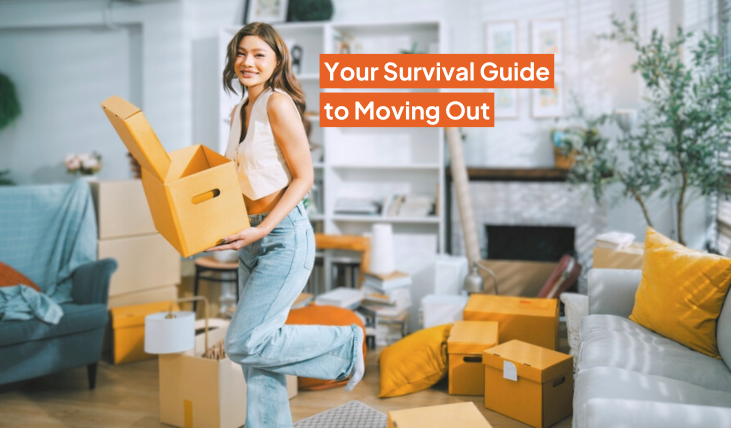
Moving out sounds like freedom. And it is. But it’s also the first time nobody is catching your mistakes for you.
There’s no parent reminding you that the lease says no pets, or that you were supposed to update your NRIC address, or that the security deposit you thought was definitely coming back… isn’t. Nobody tells you that your first month will cost nearly double what you budgeted. Nobody tells you that a flat that looks perfect in listing photos can have an aircon that sounds like a dying cat.
So before you sign anything, commit to anything, or fall in love with a flat you haven’t properly checked, read this complete moving out survival guide we’ve created for you first.
Table of Contents:
- Figure Out What You Can Actually Afford First
- Rent vs. Buy: Be Honest With Yourself First.
- Renting Smart: The Hacks That Save You Real Money
- Buying Smart: What First-Timers Actually Need to Know
- Utilities, Insurance, and Admin: Sort These Before You Move In
- Moving Day Survival
- Surviving the First Few Months: The Habits That Make It Stick
- Ready to Find Your Place?
- Frequently Asked Questions
Figure Out What You Can Actually Afford First

Scrolling listings when you don’t know your budget is the fastest way to fall in love with a flat you can’t afford. Before you open a single listing, you need two things: your real monthly take-home pay (after CPF, not before), and a realistic total of what your life will cost once you’re out.
1. The 30% rule is your ceiling, not your target
Keep all housing costs, rent plus utilities, combined, within 30% of your net take-home pay. That’s the line between comfortable and stretched. If you take home S$3,500/month, your housing ceiling is S$1,050. If that feels limiting, it’s doing its job.
2. Map out your full monthly cost before you commit to a single number
Rent is one line item. You also have utilities, groceries, transport, food, personal care, and savings. Add it all up. If the total eats your take-home, something has to change before you move, not after.
3. Build your emergency fund before you move, not while you’re in
Three to six months of expenses saved up before you leave. This is not optional, it’s the difference between a rough month and an actual crisis when your laptop dies, your landlord disputes your deposit, or you’re between jobs. Set up an auto-transfer on salary day. Treat it like rent.
Use this as your pre-move sanity check:
Expense
Estimated Monthly Cost
Rent or mortgage repayment
Varies — see sections below
Utilities (electricity, water, gas)
S$100 to S$200
Internet and mobile
S$30 to S$100
Groceries
S$300 to S$600
Transport (MRT/bus)
S$100 to S$200
Eating out / food delivery
S$200 to S$500
Personal care, health, misc.
S$100 to S$300
Savings (non-negotiable)
At least 20% of take-home
Note: These are estimates only. Your actual costs will vary depending on your lifestyle, location, and housing type. Use this as a starting point to build your own realistic budget, not as a fixed formula.

Rent vs. Buy: Be Honest With Yourself First.
The pressure to buy in Singapore is real. Property prices, the idea of “wasting” rent money, watching your peers get their BTO keys, it adds up. But rushing a purchase you’re not financially or personally ready for is one of the most stressful things you can do to yourself.
Here’s the honest filter:
4. Rent if your situation is still in motion
Not sure which area you want to settle in long-term? Career still changing? Relationship status uncertain? Savings not yet there for a downpayment plus all the extra costs that come with buying? Rent. Flexibility now is worth more than the feeling of “doing the right thing.”
5. Rent is not wasting money, rushing to buy is
Every year you rent while building savings, getting clear on where you want to live, and waiting for the right flat is not a year wasted. It’s a year of not servicing a mortgage you’re stretched for, in a location you settled on because you were in a hurry.
6. Buy when the numbers work AND your life is ready for it
Stable income, enough savings for downpayment plus costs without gutting your emergency fund, and ready to stay in the same place for at least 5 years (the HDB Minimum Occupation Period). All three, not just one.
Is Living in Yishun Better Than Its Reputation Suggests?
Renting Smart: The Hacks That Save You Real Money
Renting in Singapore comes with more hidden costs and fine print than most people expect. Here’s what to watch out for.
7. Budget for move-in costs, not just monthly rent
Your first month costs way more than one month’s rent.
You’re also paying: security deposit (1 month for 12-month lease, 2 months for 24-month), lease stamp duty (0.4% of total rent for leases over a year — about S$144 on a S$3K/month 12-month lease), SP Group deposit for new utility accounts (S$40–S$400), agent commission if applicable (up to half a month’s rent), and moving costs (S$300–S$800 for a room or small flat).
8. Take a full video walkthrough on move-in day — no exceptions
Date and time visible in the video. Every room, every wall, every appliance, every existing mark or scratch. Send it to your landlord on WhatsApp the same day. This single habit has saved countless tenants from losing their deposit over damage that was already there. Skipping it is the most expensive thing you can do on move-in day.
9. Walk the route to the MRT at the time you’d actually commute
Not on Google Maps. Not in a Grab. Walk it, at 8:30am, in Singapore humidity. A 12-minute walk in photos feels very different from a 12-minute walk in July before work. Location is your quality-of-life variable. Don’t guess it.
10. Check the aircon before you fall in love with the flat
Turn them on. Wait for them to cool down. Listen. Old, noisy, barely-cooling aircon units are one of the most common complaints from Singapore renters, and they cost you either in repair bills or in electricity running a unit that’s working twice as hard. In Singapore, functional aircon is non-negotiable.
11. Look for water stains. They tell you what photos don’t
Yellow or brown marks near ceilings, walls near pipes, or behind cabinets mean past or current leaks. Ask about them directly. If the landlord gets vague or defensive, that’s your answer. Walk away from a flat with an unresolved water leak, it will become your problem.
12. Negotiate. The market is on your side right now.
Offer a 24-month lease in exchange for a lower monthly rate, landlords value stability. Ask for minor repairs or furniture improvements before you move in instead of a price cut; they’ll often prefer fixing things over reducing headline rent.
If the unit has been listed for 3 to 4 weeks or more, ask why. That’s leverage.
13. Read the diplomatic clause section before you assume you’re flexible
If you’re on a work pass, in a job that could change, or just not 100% sure about your 12-month commitment, push for a diplomatic clause in the tenancy agreement. This lets you exit early (usually with 2 months’ notice after the first 12 months) without forfeiting your deposit.
Not all landlords will agree, but it’s worth asking.
💡 CO-LIVING IS ACTUALLY WORTH CONSIDERING
Fully furnished, bills often included, shorter lease terms, shared amenities, and lower upfront costs. It’s not just for gap-year travellers anymore. For first-time movers who want independence without the full financial commitment of a whole flat, it’s a genuinely practical option — especially while you figure out which area of Singapore you actually want to live in long-term.
Buying Smart: What First-Timers Actually Need to Know

The grants are more generous than you think. The process is slower than you think. And a few things can cost you a lot if you don’t catch them early.
Buying your first home in Singapore is one of the best financial moves most Singaporeans can make. The CPF system works in your favour, the housing grants for first-timers are substantial, and property here holds value. But it’s a long process with real traps, and the traps tend to be expensive.
14. Get your HFE letter before you fall in love with any flat
Apply for your HDB Flat Eligibility (HFE) letter via the HDB Flat Portal before you start viewing seriously. It tells you exactly what you can buy, how much in grants you qualify for, and whether you’re eligible for an HDB loan. It takes about 30 working days to come through.
15. The grants are bigger than most first-timers realise. Use them
First-timer families buying an HDB resale flat can receive up to S$230,000 in total CPF housing grants. Singles aged 35 and above are eligible for up to S$115,000. This is not a loan. It goes directly into your CPF Ordinary Account and offsets your purchase price. The lower your household income, the higher your Enhanced CPF Housing Grant.
Check your eligibility early. These grants can fundamentally change what you can afford.
16. Budget for what comes on top of the purchase price
The headline price is just the start.
On top of that: Buyer’s Stamp Duty (tiered from 1% to 4%+ depending on purchase price), legal fees (~S$2,500–S$3,500), downpayment (10% on HDB loan, usable from CPF, or minimum 25% with at least 5% cash on a bank loan), and renovation and furnishing costs (S$20,000–S$80,000 for an HDB flat depending on what you do).
Run the full number before you commit to anything.
17. HDB resale might actually be cheaper than BTO after grants
BTO flats are sold at a subsidised rate by HDB and are cheaper upfront, but you’re waiting 3 to 5 years. HDB resale flats are available now, in more locations, and come with significantly higher available grants.
Run the comparison with your actual grant eligibility before assuming BTO is the cheaper option.
18. Always check the remaining lease on older HDB flats
HDB flats come on 99-year leases. If the flat you’re looking at has under 60 years remaining, financing options get limited and the flat becomes harder to sell later. It’s not always a dealbreaker, but it’s a number you absolutely need to know before you make an offer.
19. The MOP locks you in for 5 years. Plan your life around it
Once you buy an HDB flat, you must live in it for at least 5 years (the Minimum Occupation Period) before you can sell, rent it out fully, or buy a private residential property. This means: if you buy in the wrong area, you’re there for 5 years minimum. If your life changes significantly, you’re still there. Get the location right from the start.
20. Watch the ABSD if you ever think about going private
If you want to buy a private condo while still owning your HDB flat, you’ll pay Additional Buyer’s Stamp Duty of 20% on the private property’s purchase price. On a S$1.2M condo, that’s S$240,000 extra. This is why most people sell their HDB first.
Know this rule before you start daydreaming about your move.
Utilities, Insurance, and Admin: Sort These Before You Move In

Not glamorous. Skipping it costs you more than the hour it takes.
21. Set up your SP Group account before move-in day, not on it
Register at spgroup.com.sg at least a week before you move in.
First-time accounts require a refundable deposit of S$40 tp S$400 depending on your status. While you’re at it, check the Open Electricity Market (openelectricitymarket.sg) and compare fixed-price plans versus the regulated tariff. Takes 10 minutes and can save you money every single month.
22. Sort your internet before you move in, not after
There’s usually a 1 to 2 week wait for installation. Check which providers are available at your specific address before signing up.
23. Update your address the week you move in
Use SingPass to update your NRIC. Then separately update: CPF, HDB records, all your banks and credit cards, your employer’s HR, every insurance policy, and all your delivery apps (Shopee, Lazada, Grab, FoodPanda).
24. Get home contents insurance. It costs less than a nice dinner out per month
Your landlord’s building insurance covers the structure. It does not cover your laptop, your clothes, or your furniture. A basic home contents policy costs roughly S$100 to S$300 per year. Look for one that covers your personal belongings, third-party liability, and alternative accommodation if the flat becomes temporarily unliveable.
Compare a few quotes before committing.
25. Don’t forget quarterly aircon servicing
Many tenancy agreements require it. Budget about S$80 to S$150 per unit per service (roughly S$300–S$600 per year for a 2-bedroom flat). A dirty or under-serviced aircon uses more electricity, breaks down faster, and, under some lease agreements, means the repair cost falls on you.
Moving Day Survival

This is the part that feels simple and consistently goes wrong.
26. HDB and condo moves have very different rules — know yours
HDB: No permits, but book your Town Council lift in advance and stay within allowed hours (9am–6pm). Blocking corridors or lift lobbies will get you reported.
Condo: You need to notify the MCST, book the service lift, submit a permit 5 to 7 days before moving day with your mover’s details, and pay a refundable deposit of S$200 to S$2,000. Moves are usually restricted to weekdays and Saturday mornings. Miss any step and your movers get turned away at the gate. This happens every week.
27. Book your movers 2 to 4 weeks ahead
Especially around month-end, school holidays, and December. Professional movers for a small flat or room cost S$300 to S$800; larger HDB or condo units run S$800 to S$1,500. Get at least 3 quotes and confirm they know your specific building type’s requirements.
28. Don’t try to move everything from your parents’ place
Moving out is also a chance to edit your life. A smaller, cleaner space is easier to live in. Bring the essentials. Leave the things you haven’t touched in a year. You’ll figure out what you actually need after a month in, and you’ll realise a lot of what felt essential, wasn’t.
29. Budget a first-month buffer of at least S$500 to S$1,000
The first month always costs more than you planned. Setup costs, household basics you forgot (the toilet brush, the broom, cleaning supplies. A few too many food deliveries while you figure out grocery shopping. Build the buffer in. Consider it part of the cost of moving.
Moving Out of My Childhood Home Was Harder Than I Expected
Surviving the First Few Months: The Habits That Make It Stick

The financial habits you build in year one tend to stay.
30. Electricity is your biggest controllable expense, so control it
Little habits make a bigger difference than you’d think.
Switching to LED bulbs, unplugging devices you’re not using, not running the washing machine half-empty. Keep your appliances well-maintained so they’re not working harder than they need to.
And if going green matters to you, it’s worth browsing the eco-friendly retailer options on openelectricitymarket.sg.
31. Meal prepping two to three times a week changes everything
You don’t need to go full meal-prep influencer. You just need a few ready meals in the fridge for the moments when you’re tired at 9pm and GrabFood is one tap away. Singapore’s wet markets are cheaper than supermarkets for fresh produce. Build them into your routine.
Buy non-perishables in bulk: rice, canned goods, condiments, cleaning supplies.
32. Automate your savings on salary day, before anything else
The most reliable savings system is one that doesn’t need your willpower. Set up an auto-transfer the moment your salary lands, about 15 to 20% to start. If your emergency fund isn’t fully built yet, that goes first. Everything else layers on top.
33. Revisit your budget after 3 months of real data
Your first budget is an estimate. After 3 months of actually living independently, you’ll know what you really spend and where. Most people consistently underestimate food, utilities, and the category technically labelled “miscellaneous” but really meaning “random things I didn’t think I’d need to buy.” Adjust from reality, not guesswork.
💡 FINAL THOUGHT
Moving out is one of those things that feels enormous right up until you’ve done it. Then you’re in your own space, at your own pace, building a life on your own terms. The prep is worth it. You’ve got this.
Ready to Find Your Place?

You’ve done the homework. Now it’s time to find the place worth moving out for, and starting a new chapter.
Ohmyhome’s listings are a good place to start — verified properties, no duplicates or fake listings, and full transaction data so you’re never guessing on price.
Or if you want something faster and more personalised, simply submit your preferences to us — your budget, preferred location, flat type, and room size — and with the help of our data-matching technology MATCH, our agents will quickly shortlist the options that actually fit and WhatsApp them straight to you.
Ohmyhome Super Agents are also on hand to guide you through the full process. From viewings and negotiations to paperwork, approvals, and all the way to move-in day, we make every step as smooth and straightforward as possible.
Your next chapter is waiting. WhatsApp us today to get started.
Frequently Asked Questions
1. How much money should I save before moving out in Singapore?
At minimum, have three to six months of expenses saved before you move out. This covers your emergency fund. On top of that, budget separately for move-in costs like your security deposit, stamp duty, SP Group deposit, and moving fees. The more prepared you are before you leave, the less stressful the transition.
2. Can I move out before 35 if I’m single in Singapore?
Yes, but your options are more limited. Singles under 35 cannot buy an HDB flat on their own, but you can rent. Options include renting a room or whole flat from an HDB owner, renting a private condo or apartment, or opting for a co-living space. Once you turn 35, you become eligible to purchase a resale HDB flat under the Single Singapore Citizen Scheme, with grants of up to S$115,000 available.
3. What should I look out for when signing a tenancy agreement in Singapore?
The key things to check before signing: the security deposit amount and conditions for getting it back, who is responsible for repairs and up to what cost, the early termination clause and penalties, whether a diplomatic clause is included, and what you are and aren’t allowed to do in the flat (e.g., things like keeping pets, drilling walls, or having overnight guests). Read the full agreement before signing, not just the headline terms. If anything is unclear, ask before you commit, not after.